Introduction: When One Mechanism Changes Several Fields
Few pharmacological discoveries manage to redefine more than one branch of medicine. Phosphodiesterase type-5 inhibitors (PDE-5 inhibitors) did exactly that. Initially introduced for erectile dysfunction (ED), they quickly became a cornerstone of vascular pharmacology, influencing not only sexual medicine but also cardiopulmonary therapeutics.
At first glance, their mechanism appears straightforward: inhibition of PDE-5 increases intracellular cyclic guanosine monophosphate (cGMP), enhancing nitric oxide–mediated vasodilation. Yet the clinical implications are anything but simple. This pathway governs vascular tone, endothelial integrity, and smooth muscle responsiveness across multiple organ systems.
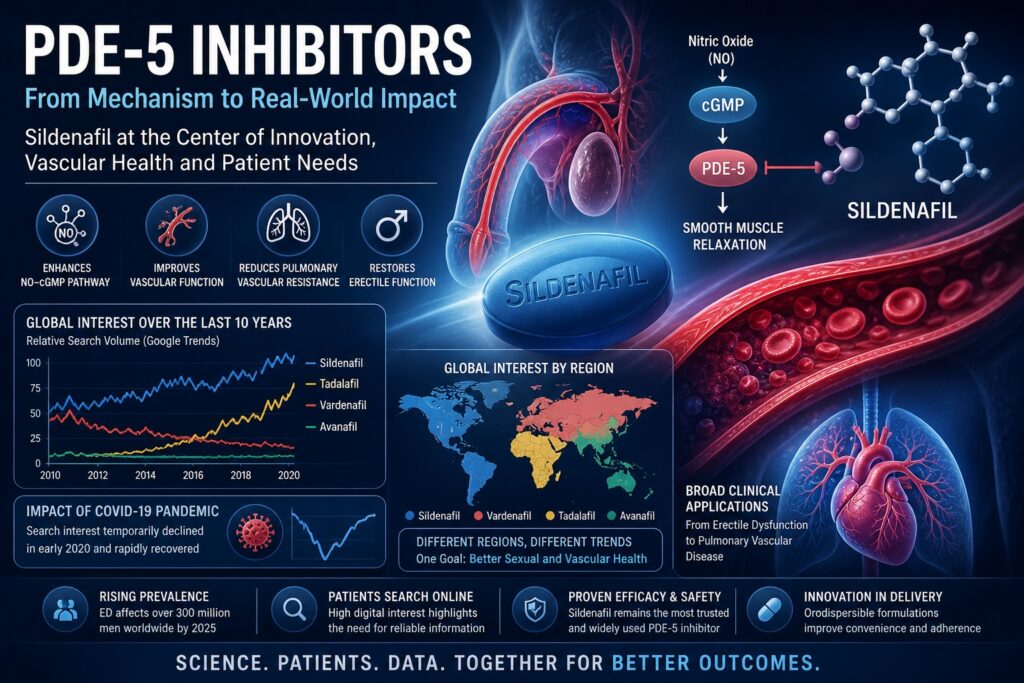
The materials you provided reveal three essential dimensions of this drug class. First, the molecular and hemodynamic effects of sildenafil in pulmonary pathology. Second, the patient-centered evolution of PDE-5 inhibitors in erectile dysfunction. Third, real-world behavioral data showing how patients interact with these drugs globally. Together, they form a complete picture: PDE-5 inhibitors are not just medications—they are tools operating at the intersection of biology, behavior, and modern healthcare systems.
Erectile Dysfunction as a Systemic Marker, Not a Local Problem
Erectile dysfunction is often misinterpreted as an isolated condition. In reality, it is frequently an early manifestation of systemic disease. Vascular impairment, endothelial dysfunction, metabolic syndrome, and cardiovascular pathology all converge in the pathogenesis of ED.
Epidemiological projections suggest that by 2025, more than 300 million men worldwide will be affected by erectile dysfunction . This is not merely a statistic—it is a signal. ED reflects broader public health challenges, including aging populations and increasing prevalence of chronic diseases.
The reluctance of patients to seek medical advice further complicates the issue. According to behavioral data, nearly half of men experiencing ED symptoms hesitate to consult a physician, often turning instead to online searches for solutions . This shift toward self-directed information seeking has significant implications: patients may encounter misinformation, counterfeit medications, or inappropriate treatment strategies.
From a clinical perspective, this underscores an important principle: treating ED is not only about restoring sexual function. It is an opportunity to identify and manage systemic disease early. PDE-5 inhibitors, therefore, operate not just as therapeutic agents but as entry points into broader health evaluation.
Mechanistic Foundations: The NO–cGMP Pathway and Smooth Muscle Biology
The physiological basis of PDE-5 inhibition lies in the nitric oxide (NO)–cGMP signaling cascade. Nitric oxide stimulates guanylate cyclase, leading to increased cGMP production. This molecule reduces intracellular calcium levels, resulting in smooth muscle relaxation.
In the penile vasculature, this process facilitates increased blood inflow and erection. In pulmonary arteries, the same mechanism reduces vascular resistance and improves hemodynamics. The universality of this pathway explains why sildenafil, initially developed for cardiovascular use, found its first clinical success in sexual medicine.
PDE-5 acts as a regulatory brake, degrading cGMP and limiting the duration of vasodilation. Sildenafil removes this brake. By inhibiting PDE-5, it prolongs the vasodilatory signal, enhancing both magnitude and duration of vascular relaxation.
This mechanism also explains the broader therapeutic potential of PDE-5 inhibitors. Their effects are not confined to a single organ but extend to any system where smooth muscle tone and endothelial signaling play a role. This includes pulmonary circulation, coronary arteries, and even certain aspects of cellular proliferation and inflammation.
Sildenafil: The Archetype of PDE-5 Inhibition
Among all PDE-5 inhibitors, sildenafil remains the most extensively studied and clinically established. Introduced in 1998, it set the benchmark for efficacy, safety, and pharmacological reliability.
Clinical data consistently demonstrate that approximately 80% of patients experience improved erectile function with sildenafil therapy . This level of efficacy, combined with a well-understood safety profile, has made sildenafil a first-line treatment worldwide.
Several factors contribute to its sustained dominance:
- Robust clinical evidence accumulated over decades
- Predictable pharmacokinetics with relatively rapid onset
- Broad applicability across patient populations and comorbidities
- Cost-effectiveness compared to newer agents
Real-world data further reinforce its prominence. As shown in the trend analysis graph on page 3, sildenafil has demonstrated a continuous increase in global search interest over the past decade, surpassing other PDE-5 inhibitors such as tadalafil and vardenafil . This reflects not only clinical effectiveness but also public awareness and trust.
Interestingly, its popularity is not purely medical. Brand recognition, accessibility, and cultural familiarity all contribute to its leading position. Sildenafil is, in many ways, both a pharmacological and social phenomenon.
Patient Behavior and Real-World Trends: Medicine Meets Digital Reality
Modern medicine does not exist in isolation from patient behavior. The rise of digital platforms has transformed how individuals seek and interpret medical information. Erectile dysfunction, due to its sensitive nature, is particularly affected by this trend.
Google Trends data reveal that global interest in PDE-5 inhibitors has doubled over the past decade . This increase mirrors the rising prevalence of ED but also reflects changing attitudes toward sexual health and self-care.
The world map on page 2 illustrates geographic variations in drug interest. Sildenafil shows particularly high popularity in South America and Europe, while other agents demonstrate regional preferences . These differences likely reflect cultural factors, healthcare systems, and local prescribing habits.
However, this digital engagement comes with risks. Patients often search for treatments before consulting healthcare professionals. This behavior can lead to:
- Use of counterfeit or unregulated medications
- Misinterpretation of symptoms and delayed diagnosis
- Lack of awareness of underlying comorbidities
The COVID-19 pandemic provided an unexpected natural experiment. As shown in the trend curve on page 3, interest in PDE-5 inhibitors temporarily declined during early lockdown periods, likely due to reduced social interaction and increased focus on pandemic-related concerns . Yet the rapid recovery of interest highlights the persistent demand for these therapies.
Innovation in Drug Delivery: Redefining the Patient Experience
Despite high efficacy, adherence to PDE-5 inhibitor therapy remains suboptimal. Up to half of patients discontinue treatment within a year, often due to dissatisfaction rather than lack of effectiveness . This paradox has driven innovation in drug delivery systems.
Orodispersible formulations, particularly sildenafil oral films, represent a significant advancement. These formulations dissolve in the mouth without water, offering a discreet and convenient alternative to traditional tablets.
The benefits extend beyond convenience. They address psychological barriers associated with ED treatment, including stigma and the desire for spontaneity. By reducing the “medicalization” of sexual activity, these formulations improve patient acceptance and adherence.
Pharmacokinetically, sildenafil orodispersible films are bioequivalent to conventional tablets, ensuring that improved usability does not come at the expense of efficacy . This combination of clinical reliability and enhanced user experience exemplifies the future direction of pharmacotherapy.
Beyond Erectile Dysfunction: Pulmonary and Vascular Applications
While sildenafil’s role in ED is well established, its impact on pulmonary vascular disease is increasingly recognized. Experimental studies demonstrate that sildenafil can significantly improve pulmonary hemodynamics, particularly in conditions such as acute pulmonary embolism.
By reducing pulmonary arterial pressure and inhibiting pathological signaling pathways, including Rho kinase activation, sildenafil addresses both the symptoms and underlying mechanisms of disease . This dual action distinguishes it from purely symptomatic therapies.
Moreover, its anti-inflammatory effects, evidenced by reductions in cytokines such as TNF-α and IL-6, suggest a broader role in modulating vascular injury and remodeling. These properties position sildenafil as a candidate for integrated cardiovascular and pulmonary treatment strategies.
The implications are substantial. A drug initially designed for one condition is now influencing multiple therapeutic domains, illustrating the power of mechanism-based pharmacology.
Clinical Strategy: Aligning Pharmacology with Patient Reality
Effective treatment requires more than understanding molecular pathways. It demands alignment with patient expectations, lifestyle, and psychological context. PDE-5 inhibitors provide an excellent example of this principle.
Patients prioritize not only efficacy but also:
- Speed of onset and predictability
- Preservation of spontaneity
- Minimal interference with daily life
- Confidence in safety and long-term use
Sildenafil meets many of these criteria, particularly when delivered through modern formulations. However, the clinician’s role remains essential. Education, follow-up, and individualized treatment planning are critical for long-term success.
Importantly, ED should always be approached as part of a broader health assessment. Identifying cardiovascular risk factors, metabolic disorders, and psychological contributors is essential. PDE-5 inhibitors are a powerful tool—but they are only one part of a comprehensive strategy.
Conclusion: A Drug Class That Continues to Evolve
PDE-5 inhibitors, led by sildenafil, have transformed from a niche therapy into a central component of modern medicine. Their influence extends from sexual health to pulmonary hemodynamics, from molecular signaling to patient behavior.
The story of sildenafil is not just about pharmacology. It is about adaptation—of science to clinical need, of therapy to patient expectations, and of medicine to a rapidly changing world.
As research continues, the boundaries of PDE-5 inhibition will likely expand even further. If history is any indication, sildenafil has not yet reached the limits of its clinical potential.
FAQ: Key Questions About PDE-5 Inhibitors
1. Why is sildenafil the most widely used PDE-5 inhibitor?
Because of its strong clinical evidence, predictable efficacy, safety profile, and long-standing presence in medical practice, supported by global usage trends.
2. Are PDE-5 inhibitors safe for long-term use?
Yes, in most patients they are well tolerated. However, proper medical evaluation is essential, especially in individuals with cardiovascular conditions.
3. Why do many patients stop using PDE-5 inhibitors despite good results?
Common reasons include psychological factors, dissatisfaction with the mode of administration, and desire for more natural or spontaneous experiences.
4. Can sildenafil be used for conditions other than erectile dysfunction?
Yes. It is already used in pulmonary hypertension and shows promising effects in other vascular and inflammatory conditions.