Introduction: Rethinking Sildenafil in Modern Medicine
The story of phosphodiesterase-5 (PDE-5) inhibitors begins with a pharmacological accident that became a clinical revolution. Originally developed to treat angina, sildenafil rapidly transitioned into a first-line therapy for erectile dysfunction. Yet, as is often the case in medicine, the most interesting effects of a drug emerge only after its initial success. Today, PDE-5 inhibitors are no longer confined to sexual medicine—they are increasingly recognized as modulators of vascular biology, inflammation, and immune function.
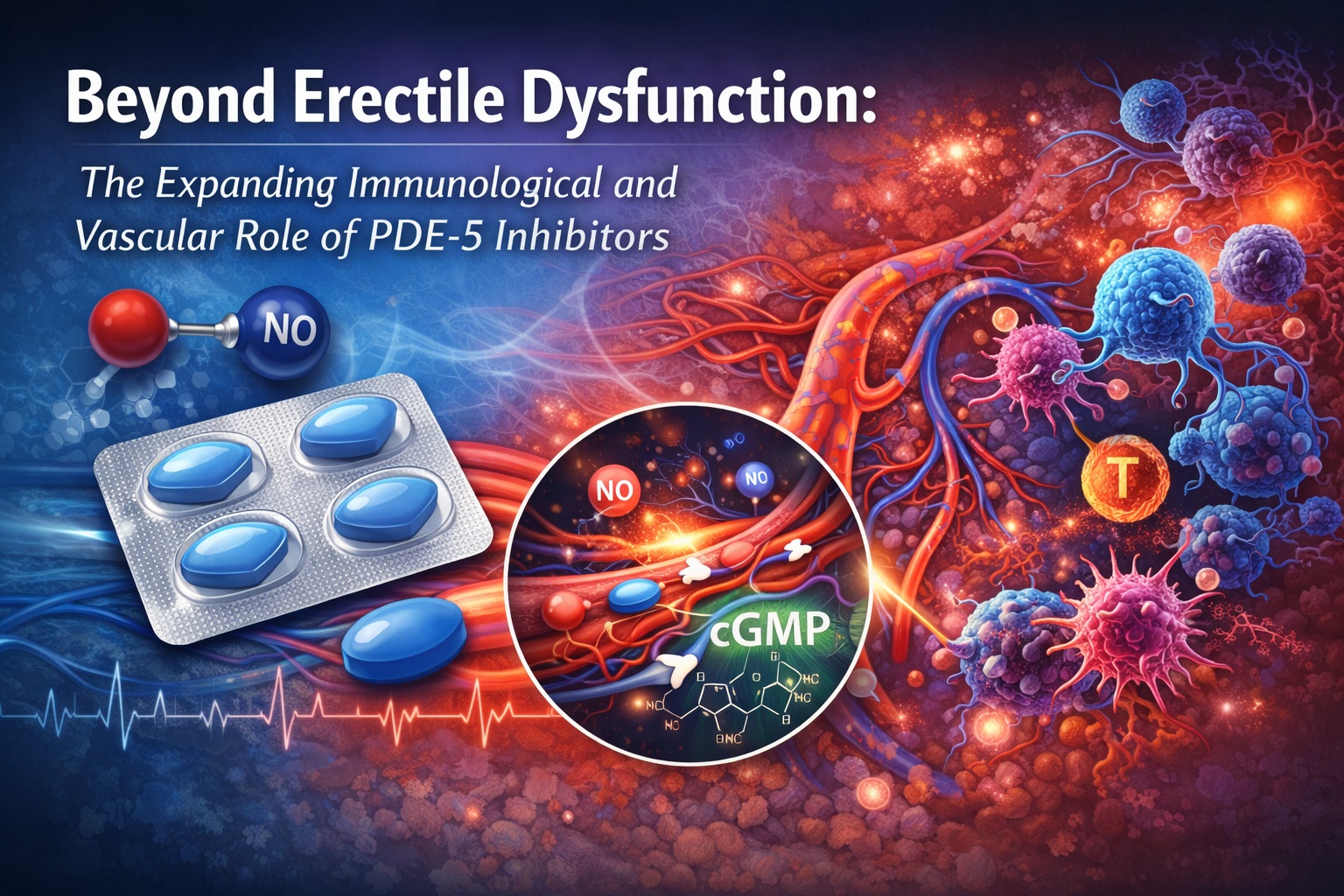
At the molecular level, PDE-5 inhibitors act by preserving cyclic guanosine monophosphate (cGMP), a signaling molecule central to smooth muscle relaxation and vascular tone. By blocking its degradation, these agents enhance nitric oxide (NO)-mediated vasodilation, improving blood flow across multiple organ systems (Википедия). What was once considered a localized effect in penile tissue is now understood as a systemic mechanism with wide-reaching implications.
Recent immunological research, including the article you provided, pushes this narrative even further. It suggests that sildenafil and related agents are capable of influencing immune responses, particularly in the context of chronic infections and inflammatory diseases. This represents a conceptual shift: PDE-5 inhibitors are not merely vascular drugs—they are immuno-vascular modulators, capable of reshaping both perfusion and inflammation.
The Molecular Foundation: PDE-5, cGMP, and Nitric Oxide Signaling
To understand the broader implications of PDE-5 inhibition, one must begin with the nitric oxide–cGMP pathway. Nitric oxide, produced by endothelial and immune cells, diffuses into smooth muscle and activates guanylate cyclase, leading to increased cGMP levels. This cascade ultimately results in smooth muscle relaxation, vasodilation, and improved tissue perfusion.
Phosphodiesterase-5 serves as a regulatory brake on this system. By degrading cGMP into inactive metabolites, it limits both the intensity and duration of NO signaling. PDE-5 inhibitors such as sildenafil effectively remove this brake, allowing cGMP to accumulate and prolonging the vasodilatory response. The result is a sustained improvement in microcirculation and tissue oxygenation.
Importantly, PDE-5 is expressed in a wide variety of tissues, including the lungs, kidneys, brain, and even components of the immune system (Википедия). This widespread distribution explains why PDE-5 inhibitors exert systemic effects. They do not simply target one organ; they modulate a fundamental signaling pathway that underlies vascular and cellular homeostasis throughout the body.
From a clinical perspective, this mechanism is elegantly simple yet profoundly versatile. Wherever nitric oxide signaling is present—and that is nearly everywhere—PDE-5 inhibitors have the potential to amplify physiological responses.
Sildenafil and Immune Modulation: A New Pharmacological Paradigm
The article you provided highlights an emerging and particularly intriguing aspect of PDE-5 inhibition: its role in immune regulation. Traditionally, inflammation has been treated with agents that suppress immune activity. Sildenafil, however, operates differently. Rather than bluntly inhibiting immune responses, it appears to recalibrate them.
Studies suggest that PDE-5 inhibitors can influence immune cell behavior by modulating intracellular signaling pathways linked to cGMP. This includes effects on macrophages, T lymphocytes, and other key players in the immune system. By enhancing cGMP signaling, sildenafil may alter cytokine production, reduce excessive inflammation, and promote a more balanced immune response (Frontiers).
In chronic infectious diseases such as tuberculosis, this mechanism becomes particularly relevant. Persistent inflammation can damage host tissues without effectively clearing the pathogen. Sildenafil has been investigated as an adjunct therapy in such conditions, with the hypothesis that improving vascular perfusion and modulating immune signaling could enhance treatment outcomes.
There is a certain irony here. A drug best known for improving blood flow in one of the body’s most delicate vascular systems may also help manage diseases characterized by immune dysregulation. Medicine, it seems, has a sense of humor—albeit a scientifically grounded one.
Vascular-Immune Crosstalk: Why Blood Flow Matters for Immunity
One of the central insights emerging from recent research is that vascular function and immune activity are deeply interconnected. Adequate blood flow is not merely a logistical necessity; it is a critical determinant of immune competence. Tissues with poor perfusion are more susceptible to hypoxia, oxidative stress, and impaired immune surveillance.
PDE-5 inhibitors improve microvascular circulation by enhancing nitric oxide–mediated vasodilation. This effect can increase oxygen delivery, facilitate the transport of immune cells, and improve the distribution of antimicrobial agents. In essence, better blood flow creates a more favorable environment for immune function.
Moreover, cGMP signaling itself has direct effects on immune cells. It can regulate processes such as cell proliferation, apoptosis, and cytokine secretion. By increasing cGMP levels, sildenafil may exert both vascular and cellular effects, bridging the gap between circulation and immunity.
This dual action—vascular and immunological—positions PDE-5 inhibitors as uniquely versatile agents. They do not simply address symptoms; they influence the underlying physiological environment in which disease processes unfold.
Clinical Applications Beyond the Obvious
While erectile dysfunction remains the most well-known indication for PDE-5 inhibitors, their clinical applications have expanded significantly. Sildenafil and related agents are now used in pulmonary hypertension, where their ability to reduce vascular resistance improves cardiac function and patient outcomes.
Emerging evidence suggests potential roles in a variety of conditions:
- Chronic inflammatory diseases, where modulation of immune signaling may reduce tissue damage
- Cardiovascular disorders, through improved endothelial function and collateral vessel formation
- Neurological recovery, via enhanced neurogenesis and vascular support
- Lower urinary tract symptoms, where improved pelvic perfusion may enhance function
These diverse applications share a common thread: the restoration of physiological balance through improved signaling and perfusion. PDE-5 inhibitors do not act as blunt instruments; they fine-tune biological systems that are already in place.
Sildenafil, in particular, has been extensively studied due to its well-characterized pharmacokinetics and safety profile. Its relatively short half-life allows for controlled dosing, while its selectivity for PDE-5 minimizes off-target effects.
Safety, Limitations, and Clinical Considerations
Despite their broad therapeutic potential, PDE-5 inhibitors are not without limitations. Their vasodilatory effects can lead to side effects such as headache, flushing, and hypotension. More importantly, they are contraindicated in patients taking nitrates due to the risk of severe blood pressure reduction (Википедия).
From an immunological perspective, the effects of PDE-5 inhibition are still being explored. While preliminary data are promising, large-scale clinical trials are needed to confirm efficacy in inflammatory and infectious diseases. The complexity of immune regulation means that interventions must be carefully calibrated to avoid unintended consequences.
Another important consideration is patient selection. The benefits of PDE-5 inhibitors may be most pronounced in conditions characterized by impaired nitric oxide signaling or vascular dysfunction. In patients with intact vascular and immune systems, the effects may be less dramatic.
Nevertheless, the overall safety profile of sildenafil and related agents remains favorable. Decades of clinical use have provided a robust understanding of their pharmacology, making them attractive candidates for repurposing in new therapeutic contexts.
Future Directions: Toward Integrated Therapeutic Strategies
The evolving understanding of PDE-5 inhibitors reflects a broader trend in medicine: the move toward integrated, systems-based approaches. Rather than targeting isolated symptoms, modern therapies aim to modulate entire physiological networks.
In this context, sildenafil represents a prototype for a new class of drugs—agents that bridge vascular and immune systems. Future research may explore combination therapies that pair PDE-5 inhibitors with antimicrobial agents, immunomodulators, or regenerative therapies.
There is also growing interest in the role of PDE-5 inhibitors in cancer, where they may influence tumor microenvironment, immune evasion, and vascular remodeling. Early studies suggest that these drugs could enhance the effectiveness of existing treatments by improving drug delivery and immune response.
If this trajectory continues, PDE-5 inhibitors may eventually be regarded not as niche therapies, but as foundational tools in the management of complex diseases. What began as a treatment for a very specific condition may evolve into a cornerstone of systemic therapy.
FAQ
1. What are PDE-5 inhibitors and why are they important?
PDE-5 inhibitors are drugs that block the enzyme responsible for breaking down cGMP, a molecule involved in vasodilation. By increasing cGMP levels, they enhance blood flow and influence multiple physiological systems, including vascular and immune functions.
2. How does sildenafil affect the immune system?
Sildenafil appears to modulate immune responses by enhancing cGMP signaling in immune cells. This can influence cytokine production, reduce excessive inflammation, and improve immune balance rather than simply suppressing immunity.
3. Can PDE-5 inhibitors be used for diseases other than erectile dysfunction?
Yes. PDE-5 inhibitors are already used in pulmonary hypertension and are being investigated for roles in inflammatory diseases, cardiovascular conditions, and even infectious diseases due to their vascular and immunomodulatory effects.
4. Are PDE-5 inhibitors safe for long-term use?
They are generally safe when prescribed appropriately. However, they should not be used with nitrate medications and require medical supervision, especially in patients with cardiovascular conditions.